
.jpg)
May 1, 2026
Breaking News: Dinosaurs Among Us

The Dawn of Peace of Mind: Attorneys enter the digital age - Ending the era of Mesozoic-era legacy platforms and putting direct case intelligence back in their hands

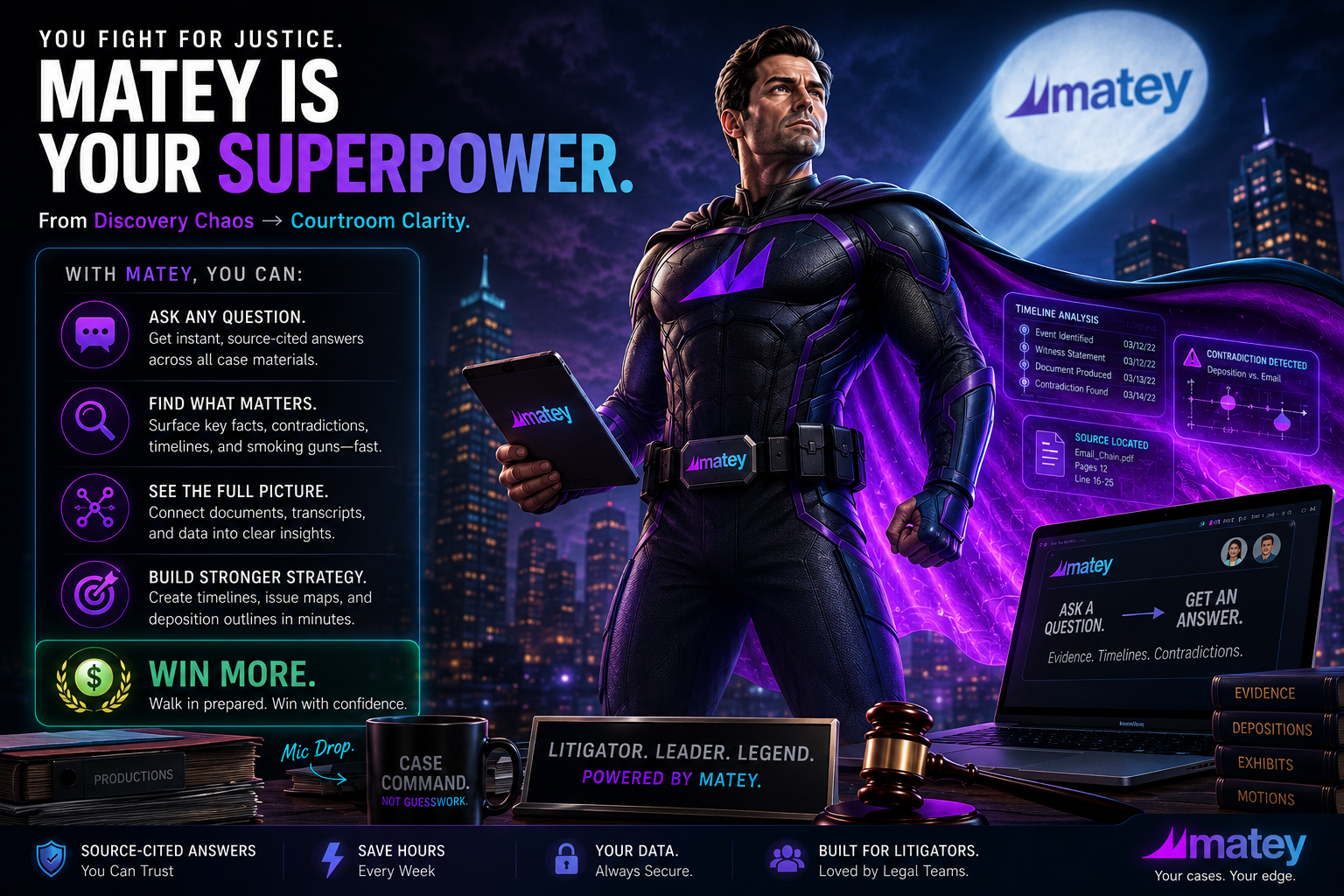
Every civil litigator knows the question.
A deposition is coming up. Mediation is on the calendar. A motion deadline is getting closer. The record is spread across emails, exhibits, transcripts, scanned PDFs, spreadsheets, production folders, and duplicate files.
Then someone asks:
Where is the document that proves this?
Not the folder where it might be.
Not the search results that might include it.
Not a summary that sounds right.
The document.
The one with the date. The statement. The attachment. The contradiction. The language that gives the argument support.
Most of the time, the problem is not that the proof does not exist. It is that the proof is buried in a record that was not organized around the questions lawyers actually need to answer.
And timing matters.
A contradiction found after the deposition is different from one found before it. A key document found after mediation does not create the same leverage. A timeline built after the strategy is already set may confirm the theory, but it cannot shape it soon enough.
That is the work civil litigators live inside every day:
Find the support.
Check the source.
Understand the context.
Use the fact while it still matters.
Lawyers think in issues, witnesses, dates, events, claims, defenses, damages, notice, causation, reliance, intent, performance, and leverage.
Discovery usually arrives as something else entirely.
Folders.
File names.
PDFs.
Emails.
Attachments.
Spreadsheets.
Transcripts.
Exports.
Scans.
Duplicates.
Partial productions.
Revised productions.
The lawyer is asking:
What happened?
Who knew?
When did they know it?
What changed?
What supports our position?
What undercuts theirs?
What do we need before this deposition?
What do we have for this motion?
The record does not answer those questions neatly.
That is why review takes so much time. The work is not just reading documents. It is connecting them.
An email may matter because of a transcript answer.
A spreadsheet may matter because of a date.
An attachment may matter because it changes who had notice.
A prior statement may matter because it gives you the cross-examination point.
A document may matter because it changes the mediation posture.
The facts are often there.
The hard part is getting to them, connecting them, and verifying them before the next case event.
Keyword search is useful. It is also limited.
It works best when you already know the exact word, phrase, name, or date that appears in the right document.
But litigation questions are rarely that clean.
A lawyer may not know the exact phrase used in the email.
The witness may describe the same event differently in testimony.
The attachment may use a different label than the pleadings.
The key document may not contain the keyword everyone is searching.
The issue may depend on connecting several documents, not finding one term.
That is why search can return too much, too little, or the wrong thing entirely.
It can find words without showing why they matter.
It can surface documents without connecting them to the witness.
It can miss the inconsistency because the record uses different language.
It can leave the team rebuilding the story manually from scattered results.
Civil litigators do not just need to find terms.
They need to know what the record actually shows.
A lot of litigation prep comes down to one gap:
The lawyer knows the question.
The source is somewhere in the record.
But getting from one to the other takes too long.
That gap shows up everywhere.
Before a deposition, when the team needs the documents tied to a witness.
Before mediation, when the team needs the facts that change leverage.
Before a motion, when the argument needs support from the actual record.
During case assessment, when the team needs to know whether the documents support the theory.
During a handoff, when one lawyer’s knowledge has to become usable for the next person.
The problem is not effort. Litigation teams are already doing the work.
The problem is the amount of time spent hunting, reopening, rechecking, renaming, remembering, and reconstructing what the record says.
That is time that could be spent preparing the witness, sharpening the outline, testing the argument, or deciding how to use the fact.
Lawyers are right to be skeptical of any tool that gives fast answers without support.
A fast answer is not useful if the team cannot verify it.
A summary is not enough if no one can see where it came from.
A confident response creates risk if it does not lead back to the document, transcript, exhibit, or timestamp.
The litigation standard has to be higher:
Ask the question. Find the source. Check the context. Then decide what to do with it.
That is why source-cited answers matter.
The answer should not replace the lawyer’s review. It should point the lawyer to the material that needs to be reviewed.
The lawyer still reads the document.
The lawyer still weighs the context.
The lawyer still decides whether the fact matters.
The lawyer still decides how to use it.
The tool should reduce the hunting, not replace the judgment.
Matey helps litigation teams ask plain-English questions across the case record and get back answers tied to the underlying source.
The workflow is simple:
Upload → Ask → Verify
Ask what the record shows about an issue.
Ask what documents relate to a witness.
Ask where the timeline changes.
Ask what conflicts with a statement.
Ask what support exists for a motion point.
Ask what facts matter before mediation.
Then verify the answer against the source.
That is the part that makes it useful for litigation. The answer is not the final product. It is the path back to the proof.
Matey helps shorten the distance between the question and the document.
The lawyer still makes the call.
For deposition prep, it means getting to witness-specific documents, prior statements, and inconsistencies faster.
For motion drafting, it means finding factual support and checking the underlying source before relying on it.
For mediation, it means identifying pressure points in the record while they can still affect leverage.
For timelines, it means building from documents and testimony instead of memory and scattered notes.
For team handoffs, it means preserving what has already been found so the next person is not starting from zero.
None of this removes the lawyer from the center of the work.
It puts the lawyer back where they should be: focused on judgment, strategy, and advocacy instead of digging through the record trying to find the same document again.
The best litigators are not the people who click through the most folders.
They are the people who know what matters once they find it.
They know when a date changes the timeline.
They know when a document changes leverage.
They know when a witness answer creates an opening.
They know when a fact supports the motion.
They know when the record is stronger, or weaker, than the client’s story.
That judgment cannot be automated.
But it can be supported.
When the team can get to the right source faster, the lawyer has more time to do the work that actually moves the case: prepare, test, argue, negotiate, and decide.
That is the point.
Not more software for its own sake.
Not another place to store documents.
Not a shortcut around verification.
A faster way to know what the record actually says.
Civil litigation will always depend on the lawyer’s command of the facts, judgment, and advocacy.
That does not change.
What can change is how quickly the team gets from a case question to the source that answers it.
Because the document that proves the point may already be in the record.
The issue is whether you can find it, verify it, and use it before the moment passes.
Ask Anything. Verify Everything.
Evidence in minutes.
Evenings reclaimed.
Proof when it matters.





.png)

.jpg)