
May 13, 2026
The Civil Litigator’s Superpower

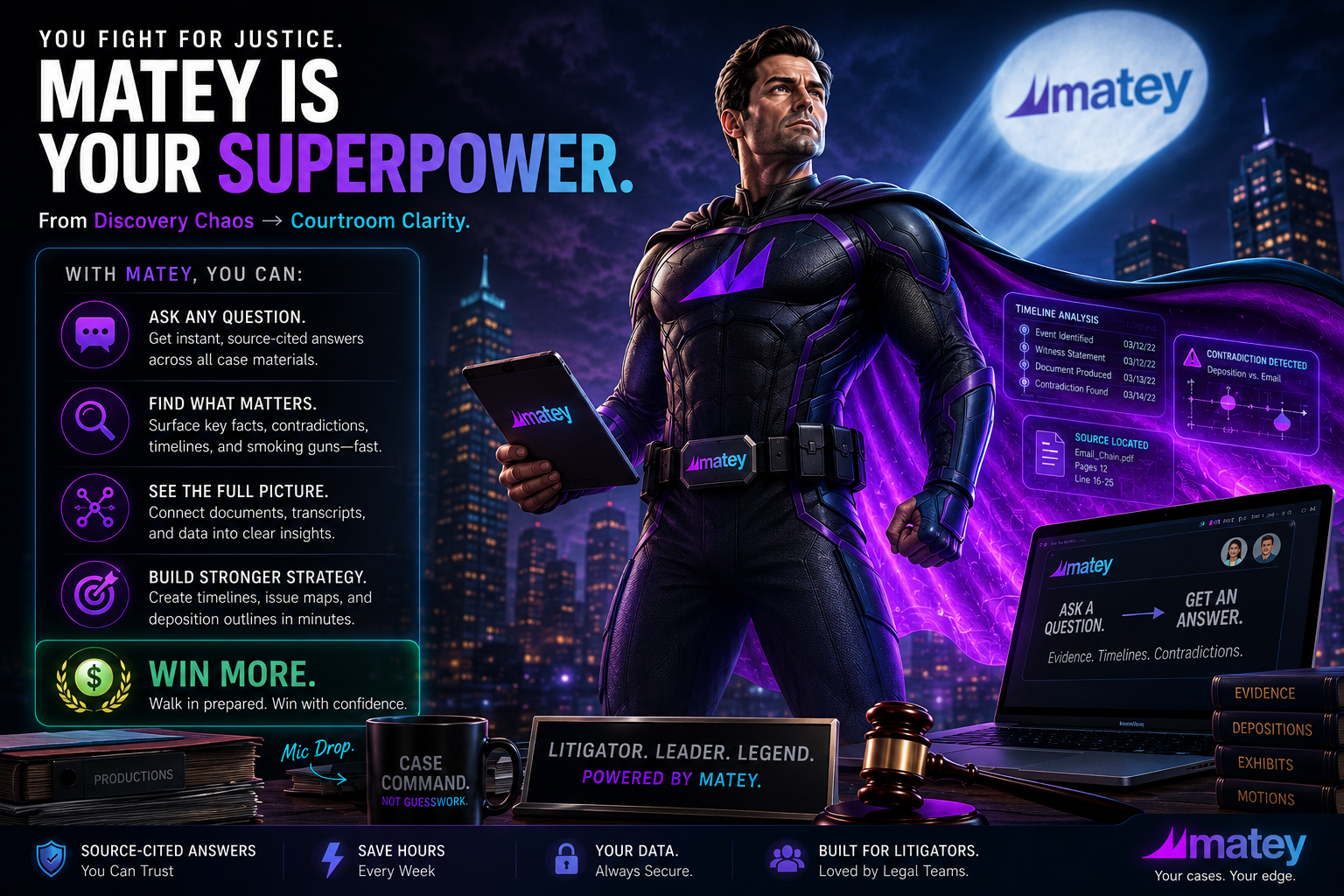
Matey helps civil litigators find source-cited proof faster, verify the record, and use key facts before the moment passes.

.jpg)
It turns out the Mesozoic Era never really ended, at least not in the legal world.
Across the country, civil attorneys are still operating in an ecosystem dominated by legacy discovery platforms: slow, expensive, and so complex they require entire teams, or outside vendors, just to function. Like dinosaurs, these systems were built for a different time, when scale meant more bodies, more hours, and more cost.
And just like dinosaurs, they’re still roaming.
Today’s discovery workflows often look something like this:
At some point, the question becomes:
is the software working for you, or are you working for the software?
The result? Attorneys are spending tens of thousands of dollars per month on tools and services that don’t actually make their work easier, just more manageable.
It’s not just inefficient. It’s backwards.
When attorneys rely on ALSPs to operate these platforms, they’re not just offloading work, they’re offloading control.
Every outsourced task comes with:
What should be a core competency, understanding your own evidence, gets handed off because the tools themselves are too difficult to use.
That’s not leverage. That’s dependency.
There’s a shift happening.
Instead of forcing attorneys to adapt to complicated systems, modern platforms are adapting to attorneys.
Tools like Matey are built around a simple idea:
You shouldn’t need to be a specialist to understand your own case.
No complex setup. No steep learning curve. No outsourcing required.
Just:
No Boolean gymnastics. No waiting in line.
Here’s where things really change.
When you eliminate:
You don’t just save money, you create margin.
That spend that used to disappear into tools and vendors?
It becomes retained value.
It becomes efficiency.
It becomes a competitive advantage.
The legal industry doesn’t need another incremental upgrade.
It needs a reset.
The era of:
is coming to an end.
What replaces it is something far simpler:
For the first time, attorneys can move through discovery without friction, without second-guessing whether something was missed, or waiting days for answers.
You’re not waiting on vendors.
You’re not digging through files hoping the right keyword surfaces the truth.
You just know.
It’s not just about speed.
It’s about clarity.
It’s about control.
And most of all, it’s about finally stepping out of the past and into a system that actually works the way you do.
The dinosaurs had their era.
Matey is the meteor that ends legacy discovery.
Verdict: Legacy Platforms Obsolete.
Proceeding to peace of mind.





.png)

.jpg)